
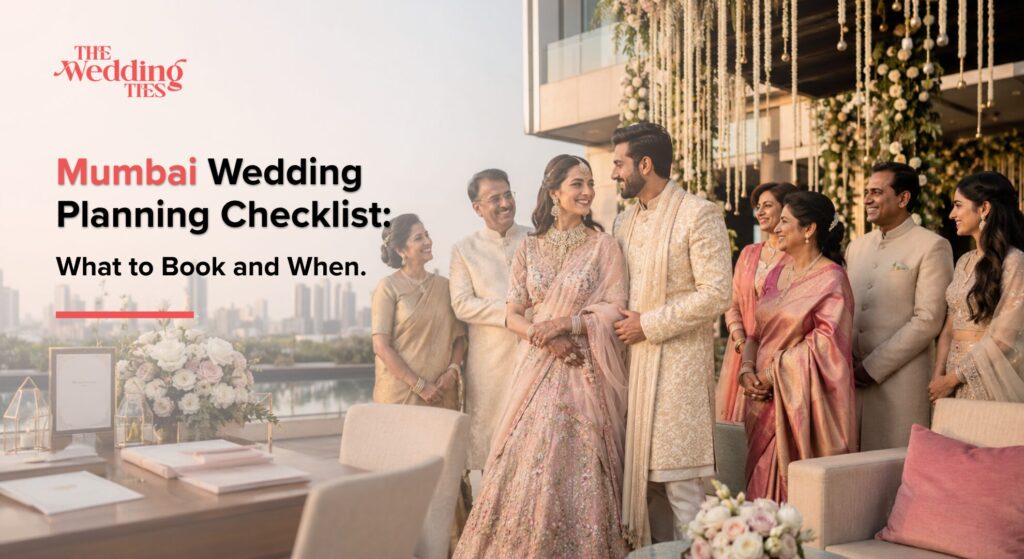

Almost every couple who sits down with us for a Mumbai wedding asks the same thing within the first ten minutes: when do we actually need to book what?
It is a fair question, and most checklists online give a fairly unhelpful answer. They hand you a generic twelve-month countdown that would read exactly the same for a wedding in Delhi, Jaipur or Dubai. Mumbai does not work like that. This city has a limited number of genuinely good venues, a season that squeezes most of the year’s celebrations into a handful of dates, a hard 10 pm cut-off on amplified sound, and traffic that can turn a twenty-minute guest transfer into an hour-long one.
So this is our version. It is the booking order we follow at The Wedding Ties when we plan a wedding in this city, along with the reason behind each deadline – because knowing why a date matters is what stops you from pushing it.
Why the Mumbai wedding calendar behaves differently?
Three things quietly control your entire booking schedule here.
The muhurat crush. Hindu wedding dates come from the panchang, and the panchang blocks out huge stretches of the year. Chaturmas takes roughly mid-July to mid-November off the table, and Kharmas closes another window from mid-December to mid-January. What is left is a small cluster of auspicious dates, mostly between November and February. Every family in the city is looking at the same shortlist. That is why a venue can be wide open on one Saturday and completely gone on the next.
Limited good venue stock. Mumbai is a space-constrained city. Once you filter for a hall that fits your headcount, has parking, allows your decorator inside and is not a two-hour drive from where your guests are staying, the list gets short very fast. Popular banquets and hotel ballrooms in areas like Dadar, Prabhadevi, Worli, Juhu and Andheri are commonly booked eight to twelve months ahead, and prime muhurat dates at the top properties go even earlier than that.
The weather split. June to September is monsoon. November to February is the stretch everyone wants: dry evenings, temperatures that sit comfortably between the high teens and low thirties, and skies that behave for an outdoor sangeet. That comfort is exactly what makes those months expensive and competitive.
Once you accept those three facts, the whole checklist below stops feeling arbitrary.
Before you book anything: three decisions that unlock the rest
You cannot book intelligently until you have settled these. We push every couple to close them in the first two weeks.
- Your date and a genuine backup. Get two or three acceptable muhurat dates from your family priest, not one. A single non-negotiable date on a peak weekend halves your venue options before you have even started looking.
- A guest number band, not a guest list. You do not need names yet. You need a range – say 350 to 450. Venue capacity, catering per-plate costs, room blocks and transport all key off this number, and changing it later is the single most expensive edit in wedding planning.
- Your budget split. Not the total, the split. How much is going to venue and food versus decor versus photography versus guest hospitality. Our Indian wedding budget breakdown walks through realistic proportions, and having those percentages in front of you makes every negotiation from here on much calmer.
12–18 months out: your planner and your venues
For a peak-season Mumbai wedding, this is where it starts. If your date sits in the November-to-February window, do not treat twelve months as early – treat it as normal.
Book now: your planner, your main wedding venue, and your sangeet or reception venue if it is a separate property.
Bring your planner in first, before the venue rather than after. A good planner will tell you which halls quietly charge a royalty for an outside caterer, which ones cap decor height, which have workable parking and which will hand you the space at 6 am on the morning of the function instead of the night before. Our venue sourcing and management team does this walk-through for every shortlist we build, and if you want the fuller picture of the role, we have written about what a wedding planner actually does in detail.
Before you sign the venue contract, get these in writing:
- Is the space exclusive to you that day, or is another function running in a neighbouring hall?
- Does the venue insist on in-house catering, and what is the royalty if you bring your own?
- Is your decorator allowed in, and what are the setup and dismantling hours?
- How many parking slots are actually yours, and what happens to guest overflow?
- What is the sound policy, and by what time must amplified music stop?
- What is the cancellation and date-change clause?
That last question matters more than people expect. Advances on Mumbai venues are substantial, and refund terms vary wildly between properties.
9–12 months: caterer, decor and photography
These three lock onto your date almost as tightly as the venue does, because the same muhurat dates that fill halls also fill every good vendor’s calendar.
- Caterer. If your venue does not do in-house food, this is the moment. Mumbai weddings often carry specific requirements – Jain menus, no onion-garlic sections, live counters, separate Gujarati or Marwari spreads and the caterers who genuinely do these well are a small group. Book the caterer now and schedule the actual tasting later, closer to three months out, when seasonal produce matches your wedding month.
- Decor. Larger structures, custom props and imported florals need production time, not just design time. Lock your decorator, then let the design evolve. Our decor designing and execution team starts with a mood direction at this stage rather than a final drawing, and if you are still gathering ideas, our guide to wedding decor themes for Indian weddings is a useful starting point.
- Photographer and videographer. The names you have been sent by three different friends are booked on peak dates a year ahead. Confirm the actual lead shooter in the contract, not just the studio, and confirm the deliverables timeline. Our photographer and choreographer desk handles this, alongside the rest of our vendor sourcing and management.
9–12 months: caterer, decor and photography
These three lock onto your date almost as tightly as the venue does, because the same muhurat dates that fill halls also fill every good vendor’s calendar.
- Caterer. If your venue does not do in-house food, this is the moment. Mumbai weddings often carry specific requirements – Jain menus, no onion-garlic sections, live counters, separate Gujarati or Marwari spreads and the caterers who genuinely do these well are a small group. Book the caterer now and schedule the actual tasting later, closer to three months out, when seasonal produce matches your wedding month.
- Decor. Larger structures, custom props and imported florals need production time, not just design time. Lock your decorator, then let the design evolve. Our decor designing and execution team starts with a mood direction at this stage rather than a final drawing, and if you are still gathering ideas, our guide to wedding decor themes for Indian weddings is a useful starting point.
- Photographer and videographer. The names you have been sent by three different friends are booked on peak dates a year ahead. Confirm the actual lead shooter in the contract, not just the studio, and confirm the deliverables timeline. Our photographer and choreographer desk handles this, alongside the rest of our vendor sourcing and management.
6–9 months: outfits, artists and invitations
Outfits. A custom bridal lehenga from a designer studio typically needs four to six months, plus two or three fittings. Off-the-rack with alterations is faster, but Mumbai’s better boutiques are also handling twenty other brides on your date. Start with the bride’s outfit, then work outward to the groom, then family.
Artists and entertainment. Singers, live bands, dhol players, anchors and DJs are booked around the same auspicious dates as everything else. There is a Mumbai-specific wrinkle here: your set list has to fit inside the sound cut-off, which we cover further down. Plan a sangeet that peaks by 9.30 pm rather than one that is meant to build until midnight. Our artist sourcing and management team builds the run sheet backwards from that deadline.
Choreography. Family dance practices need eight to ten weeks of realistic rehearsal time for people with day jobs and traffic to fight. Book the choreographer now, start sessions later.
Invitations. Design, approval rounds, printing and hand-delivery all take longer than couples expect, and in Mumbai a good proportion of cards are still delivered personally with sweets. Give yourself the runway. Our collateral design and printing team handles the full set – save-the-dates, main card, itinerary inserts, welcome collateral and our roundup of wedding invitation trends covers what couples are choosing right now.
4–6 months: guests, rooms and how people actually get there
This is where Mumbai weddings are won or lost, and it is the phase most checklists skim.
- Hotel room blocks. Release invitations, then hold rooms – in that order, so you are not paying for empty inventory. During peak season, hotel blocks near popular venues get tight, and outstation families booking their own rooms independently end up costing everyone more.
- Airport logistics. Mumbai now has two working airports. Chhatrapati Shivaji Maharaj International remains the main long-haul gateway, and Navi Mumbai International at Ulwe began commercial operations in December 2025, with international services following in 2026. Ask arriving guests which airport they are landing at, because a pickup from Ulwe to a hotel in Juhu is an entirely different journey from a T2 pickup. Build the transfer plan around real drive times, not map estimates.
- Ground transport. Shuttle buses between hotel and venue, valet, a baraat vehicle, and a separate car for elderly relatives. Our logistic management team plans call times with Mumbai’s evening traffic built in, so the baraat is not stuck on a flyover while the muhurat window closes.
- RSVPs. Start tracking now, not later. We handle this through our itinerary and RSVP service, and our guide on managing wedding RSVPs smoothly explains the system if you would rather run it yourself.
4–6 months: guests, rooms and how people actually get there
This is where Mumbai weddings are won or lost, and it is the phase most checklists skim.
- Hotel room blocks. Release invitations, then hold rooms – in that order, so you are not paying for empty inventory. During peak season, hotel blocks near popular venues get tight, and outstation families booking their own rooms independently end up costing everyone more.
- Airport logistics. Mumbai now has two working airports. Chhatrapati Shivaji Maharaj International remains the main long-haul gateway, and Navi Mumbai International at Ulwe began commercial operations in December 2025, with international services following in 2026. Ask arriving guests which airport they are landing at, because a pickup from Ulwe to a hotel in Juhu is an entirely different journey from a T2 pickup. Build the transfer plan around real drive times, not map estimates.
- Ground transport. Shuttle buses between hotel and venue, valet, a baraat vehicle, and a separate car for elderly relatives. Our logistic management team plans call times with Mumbai’s evening traffic built in, so the baraat is not stuck on a flyover while the muhurat window closes.
- RSVPs. Start tracking now, not later. We handle this through our itinerary and RSVP service, and our guide on managing wedding RSVPs smoothly explains the system if you would rather run it yourself.
2–4 months: the Mumbai paperwork nobody puts on a checklist
This section is the real reason a Mumbai checklist cannot be borrowed from anywhere else.
- Sound permission and the 10 pm rule. Under the noise pollution rules as enforced in Maharashtra, loudspeakers and public address systems are restricted between 10 pm and 6 am, with only a limited number of relaxation days notified by the state each year. The Bombay High Court’s directions on noise also treat areas within 100 metres of hospitals, schools, colleges, courts and places of worship as noise-sensitive. Permission for loudspeaker use is applied for through your local police station. Practically, this means an open-air sangeet in a residential pocket needs to plan its finale before 10 pm, while an enclosed banquet hall gives you far more freedom.
- Society NOC. If your mehendi or haldi is happening at home, your housing society will have views on decor rigging, dhol timings, lift usage, common-area access and visitor parking. Get the written no-objection early, not the week before.
- Liquor licence. Serving alcohol at a private function in Maharashtra requires a temporary one-day function licence from the State Excise Department – the Form F.L.IV licence. Many banquets and hotels arrange it as part of the package, but confirm that in writing rather than assuming. Individual consumption permits for guests are issued separately and can be obtained online.
- Traffic and police intimation. A baraat with a band moving along a main road needs the local police informed. This is routine, and it is also routinely forgotten until the morning of.
- Marriage registration. The timing here trips people up. If you are registering under the Hindu Marriage Act, the paperwork follows the ceremony and is filed through the BMC ward office or the state portal. If you are registering under the Special Marriage Act – common for interfaith couples – a 30-day public notice is required before the marriage, which means the process starts months earlier. Both routes run through Maharashtra’s official channels: the Aaple Sarkar citizen portal and the Department of Registration and Stamps e-Marriage system. Register promptly after the wedding – Maharashtra sets a short window, and late filing attracts a penalty.
1–2 months: confirm, do not create
Nothing new should enter your plan in this window. Everything should be getting confirmed and closed.
- Food tasting and final menu sign-off
- Final guest headcount to the caterer and venue
- Hair and makeup trial, plus outfit fittings
- Vendor payment schedule reconciled, with receipts filed in one place
- Gifting and hampers finalised – our hampers and gifting team assembles welcome kits for outstation guests around now
- A single master itinerary circulated to every vendor, with call times, contact numbers and load-in slots
If something is genuinely going wrong at this stage, our guide on handling last-minute wedding emergencies covers the fixes we actually use on ground.
The final week: access hours and buffers
Two Mumbai-specific things to confirm in the last seven days.
Your venue access hour. Ask precisely when your decorator can enter. If another function ran the night before, your team may only get the hall at 5 am, and a mandap that needs nine hours to install simply will not be ready. Where possible, we negotiate the previous evening’s access into the contract at signing.
Traffic-adjusted call times. Every vendor call time in the final schedule should carry a buffer built for Mumbai’s roads, especially for anything crossing between the western and eastern suburbs during peak hours.
If your wedding falls in the monsoon
June to September is genuinely cheaper, and for a smaller wedding it can be a smart choice. It just changes what you book.
Choose a covered or convertible venue rather than a lawn with a hopeful tent. Confirm power backup in writing. Ask your decorator to specify weather-resistant materials and check that flooring will not turn slippery. Add generous buffers to every guest transfer, because a Mumbai downpour affects travel time more than anything else on your run sheet. And keep a proper indoor plan B that you have actually walked through with the venue, not one that exists only as a sentence in an email.
Planning just outside Mumbai
Plenty of our couples pick Alibaug, Karjat, Lonavala or Igatpuri – close enough for guests to reach, far enough to feel like a getaway. The booking logic shifts when you do this.
Room inventory becomes the binding constraint rather than hall capacity, because your guests have to sleep there. Resorts of this kind sell out on peak dates well over a year ahead. You will also need an extra day for setup and an extra day for guest arrival, and your travel plan has to account for the specific access route – the ferry or the Atal Setu corridor for Alibaug, the expressway for Lonavala and Karjat.
If you are weighing this up, our pieces on what a destination wedding involves, the top destination wedding locations in India and planning a destination wedding in Goa all go deeper. You can also see how these played out for real couples in our real weddings gallery.
The booking mistakes we see most often
- Booking the venue before agreeing a guest number band. Everything downstream inherits the error.
- Assuming the outside decorator or caterer is allowed. Ask, then get it in writing.
- Planning an open-air sangeet that peaks after 10 pm. The sound cut-off is real and it is enforced.
- Treating registration as a post-honeymoon task. Under the Special Marriage Act especially, it starts long before the wedding.
- Holding only one acceptable date. Two or three dates roughly doubles your venue and vendor options.
- Leaving room blocks until invitations go out. In peak season, that is often too late.
- Never confirming setup access. A venue handed over at 5 am cannot host a 6 pm function that needs a nine-hour install.
Let us take the calendar off your hands
A Mumbai wedding is not difficult because any single task is hard. It is difficult because forty tasks all have their own deadline, their own vendor and their own dependency and they all sit on top of a normal working life.
That is exactly what we do at The Wedding Ties. We build the booking calendar, hold vendors to it, negotiate the contracts, chase the permissions and keep the whole thing moving quietly in the background, so your family gets to be guests at their own wedding. If you would like to see how we approach the full picture, start with our services or our guide to wedding event management and if your dates are close, our post on planning a wedding in under six months shows what is still possible on a short runway.
Tell us your date and your rough headcount, and we will send you back a booking calendar built for it.
Call us: +91 90760 01926 Email: connect@theweddingties.com Or simply get in touch here.