

Somewhere between the first family WhatsApp group and the last handful of rice at the vidaai, a Jaipur wedding stops being an idea and becomes a real, moving, 300-person operation. And if we are being honest with you, the thing that decides whether it feels royal or simply expensive is not the palace you book. It is everything you sort out quietly in the months before anyone lands in the Pink City.
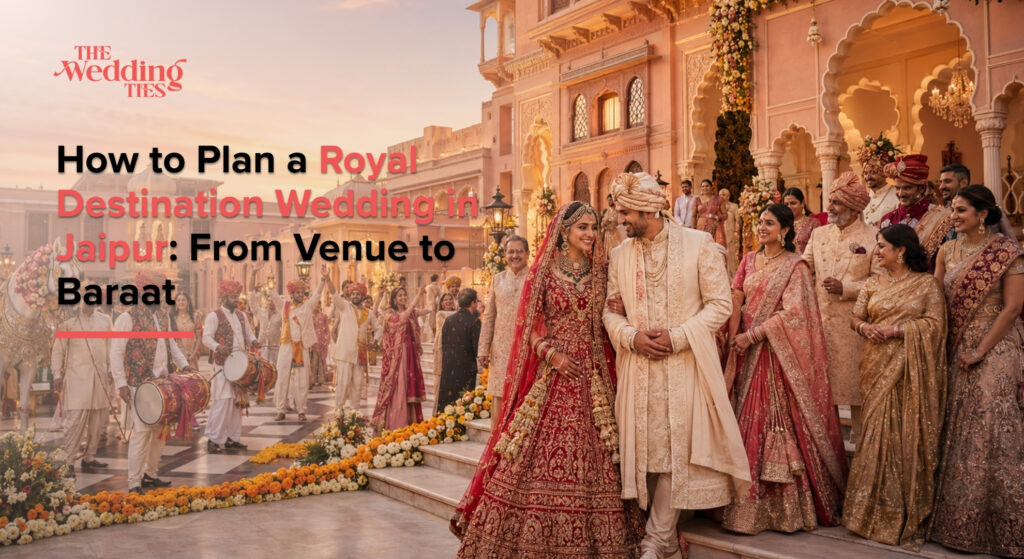
We are The Wedding Ties, and we have spent years building celebrations across Rajasthan for families who walk in with one very clear picture in their heads – a groom riding through carved sandstone gates, dhol beats bouncing off the walls, and 200 people dancing behind him with no idea how much planning went into those forty minutes.
This guide is the groundwork behind that picture, laid out in the order we actually work through it with our couples. Venue first, baraat last, and all the unglamorous bits in between that nobody puts on Instagram.
If you are still at the “which city, though?” stage, our round-up of the top destination wedding locations in India will help you compare Jaipur against Udaipur, Goa and the rest before you commit.
Start with the date, because everything else queues behind it
Couples usually want to talk venues first. We always push the calendar conversation ahead of it, and here is why.
Jaipur’s wedding season is dictated by weather, and the weather in Rajasthan is not subtle. October to March is the workable window. Within that, November to February is the sweet spot, when daytime temperatures sit in a comfortable range and evenings turn crisp enough for heavy lehengas and warm lighting to look their best. Outdoor mandaps, open-lawn sangeets, rooftop cocktails – all of it works in these months without a single guest fanning themselves with the menu card.
The catch is that everyone knows this. Peak-season dates at heritage properties carry noticeably higher rates than the shoulder months, and the best palaces get locked ten to twelve months ahead – sometimes further out if your date happens to be a heavily booked muhurat.
So here is how we suggest you approach it:
- Shortlist three to five dates, not one. A single “fixed” date hands all the negotiating power to the venue.
- Look at the edges of the season. Late October and March give you pleasant weather with far more room to negotiate on rates and availability.
- Consider a weekday. A Wednesday in mid-November will almost always get you a better package than a Saturday in December, with zero compromise on how the wedding looks or feels.
- Check the city calendar, not just the panchang. Jaipur hosts large festivals and events through winter that fill hotels city-wide and push room rates up for your guests, even if your venue is already booked.
Once your dates are shortlisted, the sequencing begins. Our guide to creating the perfect wedding timeline breaks down what needs to be locked at twelve months, six months and six weeks and if your dates are tighter than that, planning a wedding in under six months is genuinely doable with the right compressions.
Jaipur does not have one kind of venue. It has four.
“Palace wedding” is a phrase that covers wildly different experiences and wildly different bills. Before you tour anything, it helps to know which of these four you are actually looking for.
- The grand palace hotels. Properties like Rambagh Palace sit at the top of the scale – full service, immaculate lawns, staff who have run hundreds of weddings, and the kind of arrival moment that needs no decor at all. You are paying for prestige and polish, and you will usually be sharing the property with hotel guests unless you buy it out.
- Heritage forts and standalone palaces. These give you exclusivity. You take the whole property, your families live inside it for three days, and the wedding feels like a private world rather than an event booked into a venue. Ceremonial spaces are often spread across courtyards, halls and terraces, which is beautiful and which also means your guest movement plan has to be genuinely good.
- Baghs and garden estates. Mughal-style gardens with open lawns and tented setups suit multi-day celebrations of roughly 150 to 300 guests who want space and open sky without stepping down in grandeur. These are our go-to for couples who want the wedding to breathe.
- Boutique havelis and heritage hotels. For under 150 guests, a restored haveli delivers real Jaipur character, intimacy and privacy at a meaningfully softer cost than a headline palace. Smaller weddings often look better here, because the scale of the property matches the scale of the guest list.
There is also a fifth option people forget: the City Palace and other monument-adjacent locations, which are extraordinary for pre-wedding shoots and select ceremonies but come with their own approval processes and tight operating rules.
Our Venue Sourcing & Management team shortlists across all five categories based on your guest count, your budget and – this matters more than couples expect – how far your oldest guests can comfortably walk between functions
The venue contract is where most families quietly lose money
The tour is the fun part. The contract is the part that decides your final bill. These are the questions we put to every Jaipur property before a single rupee moves:
- What is the minimum room-night commitment? Most palace and fort venues price around two or three nights. If your celebration is genuinely two days, you may still be paying for three.
- Are outside vendors allowed, and at what cost? Some heritage properties charge a royalty or entry fee for external decorators, caterers, DJs and photographers. This single clause can swing your budget by lakhs.
- What are the decor restrictions? Heritage structures are protected. No drilling into stone, no rigging off certain arches, weight limits on old floors, and large installations that need prior approval – sometimes with technical drawings. Beautiful mood boards die here if nobody checked first.
- Is food and beverage exclusive to the venue? And if so, are jain, vegan and international guest requirements included or billed separately?
- What is the actual usable capacity per space? A courtyard that “holds 1,000” holds 1,000 standing. Seated, with a stage and a buffet, it may hold 400.
- What happens if it rains, or if numbers change? Get the wet-weather backup space and the cancellation and reduction clauses in writing.
- Where does the sound system have to stop, and at what time?
That last one leads us to the part almost nobody warns you about.
The permissions nobody mentions until it is too late
A destination wedding in Jaipur is not a single booking. It is a small stack of approvals, and they take time – typically a few weeks, longer for heritage properties and large-scale events.
Sound permissions. Under India’s Noise Pollution (Regulation and Control) Rules, loudspeakers and public address systems need written permission from the designated local authority, and cannot be used between 10 PM and 6 AM in open areas. State governments can relax this until midnight for a limited number of days in a year, but that is an exception, not a default. Practically, this means your sangeet’s big finish needs to be planned around a cut-off, not discovered at 9:55 PM by an unhappy police constable.
Police NOC and traffic clearance. Required for large gatherings, security and crowd flow and specifically relevant if your baraat is moving along a public road rather than staying inside a property.
Fire safety clearance. Especially where there are open flames, hanging fabric, pyrotechnics or firework elements.
Temporary liquor licence. If alcohol is being served anywhere outside a licensed hotel premises – a private palace, a fort courtyard, an outdoor lawn – you need one.
Drone permissions. Drone footage of a sandstone fort at golden hour is spectacular and worth planning for. It is also regulated. India’s Digital Sky platform classifies airspace into green, yellow and red zones, with yellow zones near airports requiring prior approval. Jaipur’s airport sits close to the city, so this is a real check, not a formality. Ask your film team for their registration and clearance well before the shoot day.
And a word on elephants. We get asked about elephant baraats often, and we say the same thing every time: the Asian elephant is protected under Schedule I of the Wildlife (Protection) Act, 1972, and commercial hire of these animals for private events is not something any family should be arranging. Regulation of captive elephants in the state sits with the Rajasthan Forest Department, and any vendor casually promising you one for a wedding procession is a vendor worth walking away from. The good news is that the alternatives are more photogenic anyway, and we will get to them shortly.
Our Logistic Management team handles these filings so your family is not chasing paperwork in an unfamiliar city three weeks before the wedding.
Moving 250 people from the airport to the mandap
Guest logistics is the single biggest difference between a destination wedding that feels effortless and one where everyone is politely exhausted by day two.
Jaipur helps you here. It is well connected by air and by road, with short flights from Delhi and Mumbai and an easy highway run from the capital – which means your guest list is not limited to people who can spare four travel days.
What still needs planning:
- A shuttle schedule, not a shuttle promise. Guests will be spread across two or three hotels. Fixed departure times, printed and pinned to the itinerary, beat “call us when you’re ready” every single time.
- Arrival buffers. Build in a welcome desk with cold towels, water and room keys ready. The first twenty minutes set the tone for three days.
- Room allocation by mobility, not by hierarchy. Elders and young families go closest to the function spaces. Nobody should be walking a kilometre in a heavy sherwani.
- A guest WhatsApp broadcast and a digital itinerary. Our Itinerary & RSVP team runs this end to end, and the earlier headcounts are locked, the cheaper everything gets – which is exactly what our guide on managing wedding RSVPs is about.
- Welcome hampers with a local hand. Blue pottery, block-printed pouches, kachori and mawa kachori from the right shop, a hand-tied safa. Our Hampers & Gifting team sources these from Jaipur’s own artisans rather than a generic gifting catalogue.
For international and NRI families, add visa advisory, multilingual signage and a short cultural briefing so every guest knows what haldi is before turmeric lands on their shoulder.
Design with Jaipur, not on top of it
Here is a mistake we see a lot: a family books a heritage fort and then covers every inch of it in imported florals and white drapes. You have just paid a premium for architecture and hidden it.
The stronger approach is to let the property do the heavy lifting and use decor to frame it. Warm uplighting on stone. Marigold and rose in local proportions. Mirror work, bandhani, gota patti and jaali-inspired backdrops that echo what is already on the walls. Our Decor Designing & Execution team designs to the venue, not against it, and our breakdown of wedding decor themes for Indian weddings has plenty of direction if you are still building a mood board.
The details that guests actually remember, in our experience, are the live ones:
- A safa-tying station with a turban artist who can do a dozen different styles – instantly turns baraatis into a proper procession.
- Lac bangle makers and block-print artisans working live during the mehendi, so guests leave with something they watched being made.
- Ghoomar and kalbeliya performers at the welcome dinner, and a folk band that transitions into the DJ set rather than competing with it.
- A dal baati churma counter alongside the global menu. Jaipur’s food is a reason people remember the wedding.
- Vintage car and jeep photo moments built into the schedule instead of squeezed in.
We book and manage these through Artist Sourcing & Management and Vendor Sourcing & Management, which also means one point of contact instead of eleven.
Now, the baraat
This is the forty minutes the whole wedding gets judged on, and it is the single most commonly under-planned element of a Jaipur celebration. Here is how we approach it.
Decide what the groom arrives on – early. A Marwari ghodi is traditional and stunning, but horses are living animals and they are genuinely unsettled by loud crackers and sudden crowd surges; you need an experienced handler and a calm approach path. A restored vintage car suits a palace driveway beautifully and is the easiest option to control. An open-top jeep gives a more relaxed, modern energy. A bagghi is grand and slow, which is either the point or a problem depending on your timeline. Pick one that suits both your groom and the physical route.
Walk the route before you book it. Inside a palace or fort property, the baraat usually travels from one gate to a courtyard – no traffic clearance needed, but you do need to check gradients, gate widths, low arches and where the band can stand. If any part of the procession touches a public road, that is a traffic and police clearance conversation, and it needs to start weeks in advance.
Build the delay into the timeline. Every baraat in India runs long, because that is the joy of it. Ours are scheduled with a deliberate buffer so that dinner service, muhurat timing and the sound cut-off are not all colliding at once. If your baraat is scheduled for 7 PM and your pheras have a hard muhurat at 9:40 PM, we plan backwards from the muhurat, not forwards from the dhol.
Sound is the constraint. Dhol and band on an open road are subject to the same timing rules discussed earlier. Plan the loudest stretch for the earlier part of the evening and design the last leg to work with acoustic percussion if needed.
Look after the people in it. Water stations along the route, a shaded holding point for elders, a couple of team members walking with the elderly, and a discreet medical kit. A baraat in a heavy sherwani in the Rajasthan winter sun is still hard work.
Choreograph the arrival, not just the walk. The milni, the varmala, the shower of petals from a balcony above – the moment the baraat lands is the shot everyone keeps. Our Photographer & Choreographer team blocks this out in advance with the film crew so nobody is improvising in the dark.
And while the groom gets the procession, the bride’s entry deserves the same thought. Our post on unique bridal entry ideas and our guide to choosing the perfect bridal entry song are both worth a read before you finalise the ceremony flow.
A three-day Jaipur wedding, roughly
Every family is different, but this is the shape most of our Jaipur celebrations take:
- Day 1 – Airport arrivals through the morning, welcome lunch, an afternoon haldi in an open courtyard, mehendi through the evening with folk musicians and artisan stations, informal dinner.
- Day 2 – Late breakfast, optional city tour or shopping run for guests, poolside or lawn lunch, sangeet in the evening with family performances and a hard finish before the sound cut-off.
- Day 3 – Morning rituals, baraat in the evening, milni and varmala, pheras at muhurat, dinner running alongside, and vidaai the next morning after a slow breakfast that everybody needs.
Two nights minimum is not a luxury in Jaipur – it is what lets a property this beautiful actually be experienced rather than photographed.
The budget conversation, honestly
Jaipur has a genuine advantage here, and it is worth saying plainly: for comparable heritage categories, Jaipur typically costs less than Udaipur while delivering equal visual impact. The dhol players, the folk musicians, the local cuisine – these are the city’s default setting, not premium add-ons you import.
Where budgets actually break is rarely the venue. It is the unbudgeted royalty fees on outside vendors, the third night nobody planned for, guest transport that was never quoted, and last-minute decor changes forced by a heritage restriction discovered too late. Every one of those is preventable with an early, honest number.
Before you sign anything, work through our Indian wedding budget breakdown so you know what proportion should sit where and what a realistic contingency looks like. And because something always shifts on the day, our guide on handling last-minute wedding emergencies is the one our couples quietly bookmark.
How we run a Jaipur wedding?
We are not a vendor who shows up in the last week. We work as a single point of contact from the first venue shortlist to the last vendor payment, which is broadly what we described in what a wedding planner actually does – applied specifically to a city where heritage properties, permissions and guest movement all have to be handled locally.
For a Jaipur celebration, that means our team is on the ground for venue negotiation and contract review, permission filings, vendor and artist booking, decor design and installation supervision, guest transport and hospitality, and full on-site coordination through every function. Families choose us because the wedding is genuinely theirs – nobody is being fitted into a template.
You can see the range of what we have built on our real weddings page, and read what families have said on our testimonials page. If you want the full picture of what a Jaipur engagement looks like with us, our dedicated page for wedding planners in Jaipur covers packages and process and if you are weighing Jaipur against Jodhpur or Jaisalmer, our wedding planners in Rajasthan compares the state’s options side by side.
Let's plan yours
A royal destination wedding in Jaipur is not about spending the most. It is about getting the sequence right – dates before venues, contracts before mood boards, permissions before installations, and a baraat that arrives on time because someone planned backwards from the muhurat.
That someone can be us.
Call us: +91 90760 01926 Email: connect@theweddingties.com Or simply enquire here — your first 30-minute consultation is on us.
Frequently Asked Questions
1. How far in advance should we book a Jaipur wedding venue?
For peak season dates between November and February, plan on ten to twelve months, and start even earlier if your date falls on a heavily booked muhurat. Shoulder months like late October and March give you more availability and more room to negotiate. If your timeline is tighter, we have pulled off beautiful Jaipur weddings in far less – it simply changes which venues are realistically on the table.
2. Is Jaipur cheaper than Udaipur for a destination wedding?
Generally, yes – for comparable heritage categories, Jaipur tends to work out more affordable while still delivering palace-scale grandeur. The bigger variable is not the city, it is your guest count, the number of nights, and whether your venue permits outside vendors without a royalty fee. We map all of this out before you sign anything.
3. What permissions do we actually need for a wedding in Jaipur?
Depending on your venue and scale, you may need a police NOC, a sound permit, fire safety clearance, a temporary liquor licence for non-hotel premises, and drone clearance for aerial filming. Most take a few weeks. Our team files and tracks these so your family never has to deal with an unfamiliar local office.
4. Can we have an elephant in our baraat?
No, and we would advise you firmly against any vendor who says otherwise. Elephants are protected under Schedule I of the Wildlife (Protection) Act, 1972, and commercial hire for private events is not permissible. A Marwari ghodi, a restored vintage car, an open-top jeep or a traditional bagghi all deliver the grand arrival you are picturing and photograph beautifully against Jaipur’s sandstone.
5. How do you manage guests who have never been to Jaipur before?
With a real system, not goodwill. Airport pickups on a fixed schedule, a manned welcome desk, room allocation planned around mobility, a digital itinerary every guest can open on their phone, shuttle timings between hotels and venue, and curated city experiences for the gaps between functions. Guests should never have to ask where they are supposed to be.
6. Can a smaller Jaipur wedding still feel royal?
Absolutely and often it feels more royal. A restored haveli or a boutique heritage hotel with 120 guests gives you exclusivity, character and genuine intimacy that a 600-person palace event cannot. Scale and grandeur are not the same thing.
7. How do we get started with The Wedding Ties?
Call us on +91 90760 01926, email connect@theweddingties.com, or book your complimentary 30-minute consultation. We will talk through your dates, guest count and the kind of celebration you are imagining – no obligation, no template.