
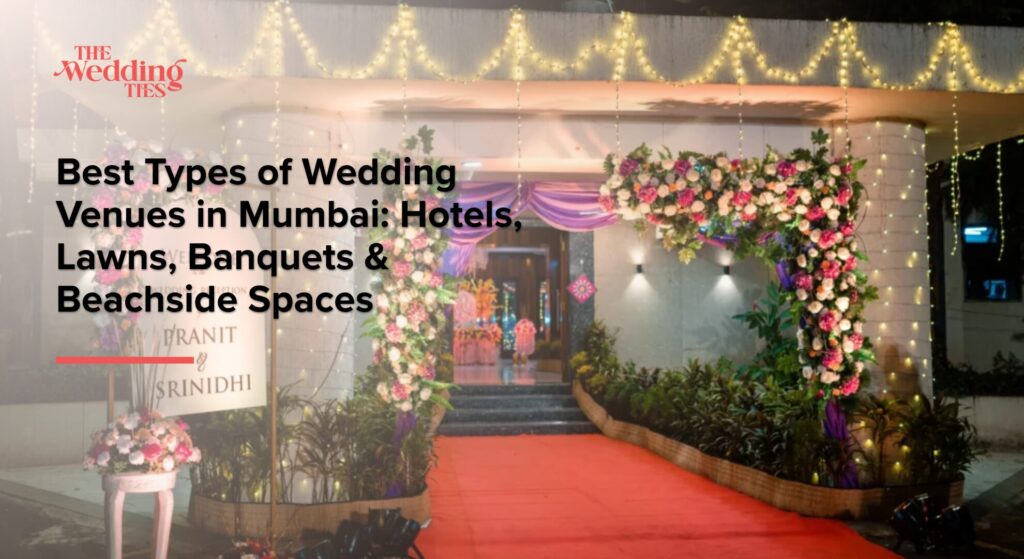

Ask any Mumbai family where they’d like the wedding to happen, and the answer is usually some version of the same sentence: “Somewhere nice, sea-facing if possible, and not too far for the guests.”
We hear it almost every week. And we completely understand it – but in Mumbai, that sentence is where the confusion begins rather than ends. This is a city built on a strip of reclaimed land, where space is the most expensive thing anyone owns. So venues here don’t try to be everything at once. Each one has evolved to do one particular kind of celebration well, and everything else only passably.
Which means the real first decision isn’t which venue. It’s which type of venue.
Get that right, and your shortlist shrinks from four hundred confusing options to about eight sensible ones. Get it wrong, and you spend three months touring properties that were never going to work for your guest list, your budget structure or your muhurat timing.
At The Wedding Ties, venue shortlisting is the first serious piece of work we do with a couple, long before décor mood boards come out. So here’s the honest breakdown we’d give you over a first coffee – what each type of Mumbai venue is genuinely good at, what it quietly costs you, and the local rules that decide more than most families realise.
Before anything else: four numbers that decide your venue type
Every venue conversation we have starts with these, in this order.
1. Your realistic guest count – not your invite list. Mumbai families routinely invite 800 and host 450. Venue capacity should be planned around who actually turns up, plus about 15% breathing room for the standing crowd near the food counters. Our blog on how to manage wedding RSVPs smoothly covers how to arrive at that honest number.
2. How many functions are on the same premises. A single reception is a very different brief from mehendi, haldi, sangeet, pheras and reception across three days.
3. Where your guests are travelling from. Two hours of Mumbai traffic between the sangeet and the pheras will quietly ruin your timeline, and no amount of décor fixes it.
4. Which pricing model your budget suits. This is the one nobody talks about, and we’ve given it a full section further down – because a ₹2,000 per plate lawn and a ₹2,000 per plate banquet hall are not remotely the same expense.
Once those four are on the table, the venue type usually picks itself.
1. Five-star hotels and hotel ballrooms
The feel: Controlled, polished, weather-proof and effortless for guests. Chandeliers, valet, air conditioning that actually works in May, and a banquet team that has done this several hundred times.
Where you’ll be looking: South Mumbai and Marine Drive for heritage grandeur and sea views, Juhu and Bandra for the beach-adjacent luxury properties, Lower Parel and BKC for modern ballrooms, and the airport belt at Andheri–Sahar for large-capacity properties that are easy for out-of-town families to reach.
Guest count sweet spot: 150 to 1,000, depending on the ballroom. Some of the landmark South Mumbai halls comfortably seat well over a thousand.
Why couples choose it: Everything lives under one roof. Guests stay upstairs, functions happen downstairs, and nobody is stuck in a car between events. For NRI families and weddings with a lot of elderly guests, this convenience genuinely outweighs everything else.
What it actually costs you: Hotels typically work on a per-plate rate with a minimum food and beverage commitment. Broadly, five-star per-plate rates in Mumbai sit in the ₹3,500–₹6,500 range, and premium South Mumbai and Lower Parel properties often move past that in peak season. The useful part: many hotels will waive or reduce the hall rental once your F&B spend crosses a threshold. So the negotiation is rarely about discounting the rate – it’s about restructuring the package.
The catch nobody mentions: Hotels usually have empanelled vendor lists. Your decorator, DJ and sometimes even your photographer may need to be from their approved panel, or you pay an outside-vendor royalty. Ceiling height in a ballroom also caps how tall a mandap or entry structure can be, which matters more than you’d think when you’re planning a dramatic bridal entry.
Best used for: Reception, sangeet, cocktail night, and any function where you want guaranteed comfort and zero weather risk.
2. Wedding lawns and open-air gardens
The feel: Open sky, marigold and mango leaves, the baraat arriving properly, and photos that don’t need a single artificial light until sunset.
Where you’ll be looking: The western and northern suburbs carry most of the city’s lawn inventory – Borivali, Malad, Goregaon, Kandivali and Mira–Bhayandar – along with Chembur and Powai, plus a wide belt across Thane, Vasai–Virar and Navi Mumbai.
Guest count sweet spot: 300 to 2,500. Lawns are the honest answer for genuinely large Indian weddings, because a hall that seats 2,000 barely exists in the city, but a lawn that holds 2,000 does.
Why couples choose it: Scale and freedom. You can build a 30-foot entrance, run a full baraat with a horse and a dhol troupe, put in a proper dance floor, and light the whole thing however you like. If you’ve been collecting ideas from our post on top wedding décor themes for Indian weddings, a lawn is where those ideas have room to actually happen.
What it actually costs you: This is where the maths changes shape. Lawns usually charge venue rental separately from catering – rental can run anywhere from around ₹60,000 for a modest suburban lawn to several lakhs for a premium one, with catering commonly quoted between ₹500 and ₹3,200 per plate depending on the area and menu. Suburban lawns in Borivali or Vasai sit at the lower end; sea-facing or premium city lawns sit at the top.
The catch nobody mentions: A lawn is an empty rectangle of grass. Flooring, tenting, stage, seating, lighting, cooling fans, power backup, washroom units and the mandap are all built from zero. Families regularly underestimate this and then discover the “cheaper” venue cost more in the end. That’s not an argument against lawns – it’s an argument for costing them properly, which is exactly what our Indian wedding budget breakdown walks you through.
The second catch is monsoon. From June to September, an outdoor-only venue without a covered fallback is a gamble we don’t advise taking.
Best used for: Pheras and the main wedding day, sangeet with a big performance stage, and any celebration where the guest list refuses to shrink.
3. Banquet halls, club halls and community halls
The feel: Practical, contained, air-conditioned and reliable. Not glamorous by default, but transformable and by a distance the best value per guest in the city.
Where you’ll be looking: Everywhere. Andheri East and West carry the densest cluster, followed by Malad, Goregaon, Chembur, Ghatkopar, Dadar, Thane and Vashi. This bracket also includes samaj halls, gymkhana banquets and club halls, which many Mumbai families already have access to through membership or community.
Guest count sweet spot: 100 to 800, though the larger convention-style halls go further.
Why couples choose it: Cost and control. Mid-size banquets commonly quote in the ₹1,800–₹3,000 per plate range for vegetarian menus, and community halls can go considerably lower on a flat daily rental. Everything you need – AC, flooring, washrooms, lighting rig, parking, furniture – is already installed, so your décor budget goes into looking good rather than building basics.
The catch nobody mentions: Three things, and we check all three on every site visit.
Pillars. A hall with columns down the middle will break sightlines to the stage. Ask for the seating layout, not just the capacity number.
In-house catering lock-in. Many banquets don’t allow outside caterers at all. If your family has a caterer they’ve used for three generations, confirm this before you fall in love with the hall.
Slot timings. A lot of Mumbai banquets run two events a day, morning and evening. That gives you a tight load-in window, and it’s a common reason décor teams end up rushing. If your setup is elaborate, negotiate a full-day booking even though it costs more.
Best used for: Mehendi, haldi, engagement, smaller receptions, and full weddings where budget discipline matters more than a view.
4. Beachside and sea-facing venues
The feel: Sea breeze, salt air, sunset ceremonies, and photographs the rest of your guest list will be jealous of.
Where you’ll be looking: Juhu and Versova for beachfront hotels, Madh Island, Aksa, Marve, Erangal and Gorai for resort properties with lawns opening towards the water, Manori for quieter boutique options, and Marine Drive and Worli for rooftop and sea-view spaces that give you the ocean without the sand.
Guest count sweet spot: 100 to 700. Some of the larger Madh and Aksa properties do handle bigger – The Retreat Hotel & Convention Centre on Madh Island and The Resort at Aksa Beach both run substantial event lawns overlooking the water.
The honest expectation-setting we always do: There is a real difference between a beach-facing venue and a wedding on the beach. Almost every “beach wedding in Mumbai” you see is the first one – a private lawn, deck or poolside within a resort that happens to overlook the Arabian Sea.
Weddings physically on the open sand are a different matter entirely, because Mumbai’s shoreline falls under Coastal Regulation Zone rules and public beaches involve municipal and police permissions, restrictions on structures, and no guarantee of privacy. Couples who arrive expecting sand-and-vows and are shown a lawn with a sea view often feel let down – so we’d rather say it upfront.
The catch nobody mentions:
Wind. Coastal wind ruins tall floral installations, tears drapes and makes open-flame décor impossible. Structures have to be engineered, not just styled.
Sound. Open coastal air swallows audio. You need a properly specced system, not a standard hall setup.
Salt and humidity. It affects hair, makeup, printed stationery and anything metallic. We plan touch-up points into the timeline for coastal functions.
Access. Madh, Marve and Gorai are beautiful and genuinely feel like a getaway, but the approach roads are narrow and ferry crossings are involved for some routes. Guest transport needs to be organised, not improvised – which is why our logistics management team maps every route before we confirm a coastal venue.
Best used for: Sunset pheras, mehendi and haldi brunches, welcome dinners and cocktail evenings. If you love this look but want it at full scale, our guide to planning a destination wedding in Goa covers the same aesthetic with far more coastline to work with.
5. The almost-destination option: resorts just outside Mumbai
Worth knowing about, because it solves a problem the city can’t. Karjat, Alibaug, Lonavala, Khandala, Igatpuri and the Nashik vineyard belt are all within roughly two to four hours, and they offer something no Mumbai venue can: a full property buyout.
You get the entire resort. Your guests stay on site, functions run late into the evening without a neighbouring society complaining, and the whole thing feels like a destination wedding without international flights. Per-plate rates are frequently lower than city five-stars, though accommodation and guest transport shift into your budget instead.
The trade-off is attendance. Every hour of travel trims your guest list, and elderly relatives may not make the trip. If a wider list of destination options interests you, we’ve covered them in top 7 destination wedding locations in India and explained the format itself in what is a destination wedding.
The Mumbai rules that quietly shape your wedding
This is the section most venue guides skip, and it’s the one that affects your evening most.
The 10 PM rule is real. Under the Noise Pollution (Regulation and Control) Rules, 2000, loudspeakers and public address systems cannot be used between 10 PM and 6 AM, and permission from the designated authority is required to use them at all. Enclosed premises such as banquet halls and auditoriums are treated differently from open venues.
State governments can relax the deadline to midnight for a limited number of days in a year for cultural occasions, but that relaxation is announced state-wide and can’t be assumed for your date. The Bombay High Court has directed strict enforcement of these rules in Maharashtra, and police enforcement in Mumbai is genuinely active.
What this means practically: an open lawn sangeet cannot run till 1 AM. If your family expects a late night of dancing, an enclosed banquet or hotel ballroom is the sensible choice, and the timeline has to be built backwards from the cut-off. We factor this into every schedule we build – our post on how to create the perfect wedding timeline explains the method.
Silence zones. Areas within roughly 100 metres of hospitals, schools, colleges and courts carry tighter restrictions. Some otherwise-perfect venues sit inside one.
Parking is a capacity number too. A venue that seats 600 but parks 60 cars will create chaos on a Mumbai arterial road. Ask for the car count, not just the guest count.
Baraat routes need permission. A procession on a public road requires local police clearance, and the route, timing and duration all get scrutinised.
Load-in windows. City venues rarely hand over the space the previous night. Confirm exactly when your décor team can enter – this single detail decides how ambitious your setup can be.
Monsoon. June to September brings real risk. Hybrid venues with both a hall and a lawn are the safest outdoor bet, and a wet-weather plan should be written into the contract, not discussed on the day. We keep contingency planning central to everything, as we’ve written about in handling last-minute wedding emergencies.
Matching venue type to each function
Most Mumbai weddings use two or three venue types across the celebration rather than forcing everything into one. Here’s how we generally distribute it.
Function | Venue type that suits it best | Why |
Mehendi | Lawn, poolside, terrace or a mid-size banquet | Daytime, relaxed, needs seating clusters rather than a stage |
Haldi | Garden, poolside or beachside deck | Messy by design – outdoors is far easier to reset |
Sangeet | Hotel ballroom or enclosed banquet | Sound quality, AC, and no 10 PM open-air cut-off |
Pheras | Lawn or beachside at sunset | Space for the mandap, baraat and open-sky rituals |
Reception | Hotel ballroom or premium banquet | Guest comfort, weather-proof, easy access |
If you want ideas for the moments that sit inside these functions, our posts on unique bridal entry ideas and planning the perfect haldi ceremony are good places to start.
Three pricing models and how to read a quote properly
This is the single most useful thing we can hand you.
Model A – Per plate with an F&B minimum (hotels, most banquets). The quoted rate includes food and service. Hall rental may be waived once your spend crosses a set figure. Ask exactly what the rate covers: welcome drinks, live counters, dessert stations and service staff are frequently priced separately.
Model B – Rental plus your own caterer (lawns, community halls, some clubs). You pay for the ground, then build everything on it. Cheaper on paper, and often not cheaper in total once flooring, tenting, power and washrooms are added. Ask whether there’s a caterer royalty for bringing your own.
Model C – Buyout (resorts outside the city, boutique properties). One negotiated figure for the whole property for a fixed number of days, usually with a minimum room-night commitment. Simplest to manage, hardest to compare against the other two.
Whichever model you’re looking at, these get asked before anything is signed: taxes and service charges, alcohol licence and corkage, DJ and sound cut-off time, outside vendor royalties, complimentary rooms, changing rooms, generator backup, overtime charges per hour, damage deposit, and the cancellation and postponement clause.
Reviewing exactly these terms is part of our venue sourcing and management service, and it’s where we most often save families more than our own fee.
How we shortlist venues for our couples
We don’t send a list of forty venues and let you drown in it. Our process is deliberately narrow.
We start with your guest number, budget model and function map. From there we shortlist five to eight venues maximum, all of which we’ve either worked at or personally inspected. We visit with you and while you’re looking at how the lawn photographs, we’re checking the load-in gate width, the generator, the kitchen distance from the service area, the washroom count, and where the sound cut-off will land.
Then we negotiate – not just the rate, but the structure of the deal and we read the contract line by line before it reaches you.
Once the venue is locked, everything else follows from it. Décor design and execution is built to that specific space rather than to a generic mood board. Vendor sourcing accounts for the venue’s panel rules. Artist and entertainment planning is scheduled around the permitted sound hours. And itineraries and RSVPs are built around real Mumbai travel times, not optimistic ones.
You can see how this comes together across the celebrations in our real weddings gallery.
Frequently asked questions
1. How far in advance should we book a wedding venue in Mumbai?
For peak season dates between November and February, and for any strong muhurat date, eight to twelve months ahead is realistic for the popular venues. Off-peak months from May to September are considerably easier and often 10–15% cheaper. If your timeline is tighter than that, it’s still very doable – our guide on planning a wedding in under six months is written exactly for that situation.
2. Which is genuinely cheaper - a lawn or a banquet hall?
A banquet hall, in most real-world cases. The lawn’s rental looks lower, but flooring, tenting, cooling, power backup, washrooms and full décor build-out usually close the gap and then some. Lawns win on scale and atmosphere, not on cost.
3. Can we get married on an actual Mumbai beach?
On a private beach-facing property, easily. On open public sand, it’s complicated – coastal zone regulations, municipal and police permissions, restrictions on permanent structures and no privacy control. We’re happy to explore it, but we’ll tell you honestly what’s achievable for your date.
4. Can our sangeet run past midnight?
Only in an enclosed venue, and even then within the venue’s own licence terms. Open-air music has to stop at 10 PM unless a state-notified relaxation applies to your date. Plan the celebration around this rather than hoping for an exception.
5. Do we still need to register the marriage separately?
Yes. The ceremony and the legal registration are two different things. Registration in Maharashtra is handled through the state’s Aaple Sarkar citizen services portal, and we help our couples keep that paperwork on schedule alongside everything else.
6. Can one venue handle all our functions?
Some can, particularly larger hotels and resorts with both indoor and outdoor spaces. It’s the easiest option for guests, though it does mean every function shares one backdrop. Many of our couples prefer two venues – an open space for the day functions and pheras, an enclosed one for sangeet and reception.
Let's find the right one for you
Mumbai has a venue for every kind of wedding – the trick is knowing which type your celebration actually needs before you start touring properties. Hotels give you polish and convenience. Lawns give you scale and open sky. Banquets give you value and control. Beachside gives you a view you’ll remember for the rest of your life. And an hour or two outside the city gives you the whole place to yourselves.
Tell us your guest count, your dates and roughly what you’d like the evening to feel like, and we’ll come back with a shortlist worth visiting.
Call us: +91 90760 01926
Email: connect@theweddingties.com Or simply enquire here.