
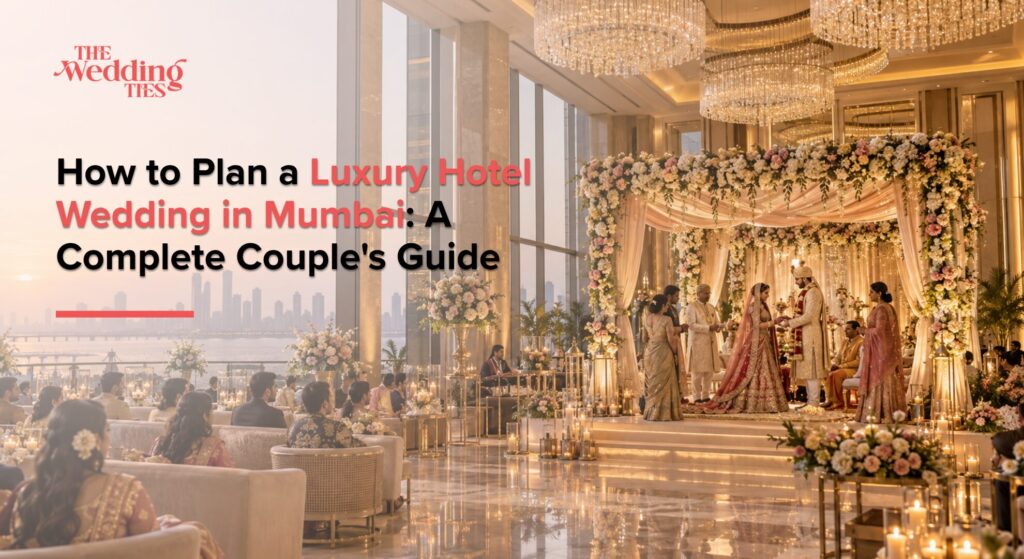

“We want a proper five-star wedding.”
We hear that sentence in almost every first meeting, and we always smile, because the couple saying it and the couple we’ll be six months later are two very different people. Right now it means chandeliers, valet parking and a ballroom that photographs beautifully. Six months from now it will mean minimum guarantees, room-night commitments, rigging points and a load-in window.
That gap is what this guide closes.
A Mumbai hotel wedding is the most comfortable format the city offers. Your guests sleep upstairs, the functions happen downstairs, and nobody spends three hours in traffic between the sangeet and the pheras. But it is also the most contractual format. You are not hiring a hall – you are signing into a commercial agreement with a hotel that has run several hundred weddings and knows exactly where its margins sit.
We’ve written this the way we’d talk you through it over a long first coffee at The Wedding Ties. Not which hotel to pick – we’ve covered venue types already in our guide to the best types of wedding venues in Mumbai. This one is about how a hotel wedding actually works, step by step, from the first enquiry to the final settlement.
What a luxury hotel wedding really gives you (and what it quietly takes)
What you gain is a single point of accountability. One property provides the space, the kitchen, the service staff, the rooms, the power backup, the parking, the security and the licences. If the AC fails, one team fixes it. If a guest needs a room at midnight, one desk handles it. For families with elderly relatives, NRI guests or a tight three-day schedule, that reliability is worth a great deal.
What you give up is a measure of creative and commercial freedom. Catering is almost always in-house and non-negotiable. Décor and entertainment often have to come from an approved panel or attract a royalty. Ceiling heights cap how tall your structures can be. Your sangeet ends when the hotel’s licence says it ends.
Neither of these is a problem. They only become problems when a family discovers them in month seven instead of month one.
Step 1: Settle three numbers before you tour a single property
Hotels quote against numbers, not against vision boards. Walk in with these three settled and you’ll get accurate proposals instead of polite estimates.
1. Your date, and how flexible it is. Mumbai’s peak wedding season runs November to February, and a strong muhurat date inside that window is the single most expensive thing you can ask for. The same ballroom on a Tuesday in July is a different conversation entirely. If you have two or three acceptable dates, say so – flexibility is your strongest negotiating asset and it costs you nothing.
2. Your guest split, not just your guest count. This is the number couples get wrong. A hotel needs two figures: how many people will eat, and how many will sleep. Four hundred guests of whom forty need rooms is a completely different deal from four hundred of whom two hundred need rooms. Room nights are where hotels make real money, and they will trade generously against them.
Work out the honest attending number first – our post on managing wedding RSVPs smoothly covers how to get to a figure you can actually rely on.
3. Which functions are happening on the property. A reception only? Or mehendi, haldi, sangeet, pheras and reception across three days? Multi-function bookings command far better terms because you’re buying the property’s time, not just one evening.
Step 2: Read the ballroom the way a planner reads it
On a site visit, most families look at the chandeliers and the carpet. We’re looking at seven other things, and they decide more about your wedding than the décor ever will.
Ceiling height. This caps your mandap, your entry arch and your hanging floral installation. A ballroom with a 14-foot ceiling and one with a 22-foot ceiling produce visibly different weddings.
Rigging points and load limits. Ask what can be hung from the ceiling and how much weight it takes. Many hotels allow nothing at all, which means every structure has to be floor-supported – a real design constraint and a real cost.
Pillars and sightlines. Ask for the seating floor plan, not the capacity figure. A column in the wrong place means two tables that can’t see the stage.
Pre-function area. The space outside the ballroom where guests gather, welcome drinks are served and your photo wall goes. A large hall with a cramped pre-function area creates a bottleneck at exactly the moment your guests arrive.
Bridal holding room. Where the bride waits before her entry. Its distance from the ballroom door decides whether your entry is graceful or hurried. If you’re planning something elaborate from our unique bridal entry ideas, walk that route yourself.
Baraat assembly and route. Where the procession forms, and whether it moves through the lobby, the porch or a side driveway. Hotels have firm views on this, and it’s better to know them early.
Service access. How far the kitchen is from the hall, and how wide the goods entry is. A narrow load-in gate quietly limits how ambitious your décor can be.
Take photographs of all of it. By your fourth site visit, the halls blur together.
Step 3: Understand how the hotel actually prices your wedding
Hotel banqueting runs on a minimum food and beverage guarantee. You commit to a spend figure; the hall rental is then waived, reduced or folded in. The headline per-plate rate is only one part of it.
For context on current market levels, industry estimates put per-plate catering at Mumbai’s top hotels in the region of ₹4,000 to ₹9,000, with total budgets for 200–500 guests across two to three days commonly landing between ₹1.5 crore and ₹5 crore, and ballroom hire quoted anywhere from ₹4 lakh to ₹25 lakh for an evening. Treat these as a sense of scale, not a quotation – your own numbers depend entirely on property, season and function count.
The levers that genuinely move a hotel quote:
Off-peak dates and weekdays. The largest single saving available to you.
Total room nights committed. The more rooms, the softer the F&B terms.
Number of functions. Three functions in one property is a package; one reception is a transaction.
Contract timing. Hotels close their year-end and quarter-end banquet numbers like any business.
What to ask before any figure is agreed:
Whether taxes and service charges are included or added on. What the per-plate rate actually covers – welcome drinks, live counters, dessert stations and mocktails are frequently priced separately. Whether there’s a royalty for outside décor, sound or photography vendors. How many complimentary rooms come with the booking. What the overtime rate is per hour past the contracted end time. And the cancellation and postponement terms in full, in writing.
If you’re still assembling the wider financial picture, our Indian wedding budget breakdown shows how these numbers sit against everything else.
Step 4: The room block - the part nobody explains
This is where hotel weddings differ most from every other venue format, and where families lose money without realising it.
A room block reserves a set number of rooms at an agreed rate for your guests. Three things inside it matter.
The cut-off date. Usually 30 days before the wedding. Unsold rooms return to the hotel’s inventory after it, and guests booking later pay the going rate – which in Mumbai’s peak season can be considerably higher.
The attrition clause. This is the one to read twice. Many contracts hold you financially responsible for a percentage of unsold rooms – often 80% of the block. Negotiate the block to your confident number and add rooms later rather than blocking optimistically and paying for empty ones.
What’s bundled in. Complimentary rooms scale with the block, typically one free room per a set number booked. Also negotiate: a suite for the couple, early check-in and late checkout for outstation guests, breakfast inclusion, and whether guests book through a dedicated link or by naming your wedding at reservations.
Then decide, clearly and early, who pays for what – the family, or the guest. Put it on the invitation itself, or on your wedding website. This single ambiguity causes more awkward phone calls than anything else in a hotel wedding, and our post on wedding invitation trends covers cleaner ways to communicate it.
Step 5: Food, tasting and the plate count
In-house catering is the rule at five-star properties. That’s less limiting than it sounds – these kitchens are genuinely excellent – but it means the menu conversation needs structure.
Book the tasting properly. Ask for it after the contract is signed but well before the menu is locked, and bring the three or four people whose opinion will actually decide things. A tasting with twelve relatives becomes a debate, not a decision.
Go through these at the tasting, not after it:
Separate sattvic or Jain preparation, if your family requires it – this affects kitchen workflow, not just the recipe
Which live counters are included and which are charged extra
Service staff ratio per guest, and whether your event is sharing staff with another function that evening
Midnight or late-night snack service, if the celebration runs long
Whether the rate is per plate or on consumption, and how leftover plates are settled
On the count itself: hotels bill on guaranteed numbers, not on who turns up. Guarantee a figure you’re confident of and agree an upward revision window – most properties accept increases up to 72 hours before. Guaranteeing high to be safe is a very expensive form of reassurance.
Step 6: Décor, the vendor panel and the load-in window
Most Mumbai hotels maintain an empanelled vendor list. Using someone outside it usually means paying a royalty, and occasionally isn’t permitted at all.
This is worth checking on your very first enquiry, because a family decorator or a photographer you’ve already fallen in love with can become an unexpected line item. Where an outside vendor matters to you, it is almost always negotiable – but negotiate it into the original contract, not afterwards.
Hotel-specific rules your décor team will need in writing:
What may be fixed to walls, ceilings and floors – most properties prohibit nails, drilling and adhesives entirely
Whether open flame, real candles or sparklers are allowed indoors
The exact hours your team may access the hall for setup and dismantling
Whether an event is booked in the same hall the previous evening
Additional power load available for lighting and sound, and how it’s billed
That fourth point decides everything. City hotels rarely release a ballroom the night before, which can compress an elaborate setup into a handful of hours. If your concept is ambitious, negotiate a full-day or previous-evening handover – it costs more and saves the design.
Our décor design and execution team builds to the specific ballroom’s constraints, which is why we confirm all of this before a mood board is ever presented. For inspiration within those limits, our guide to wedding décor themes for Indian weddings is a good starting point.
Step 7: Alcohol, permissions and the paperwork
Maharashtra is a permit state, and this catches families out.
Most five-star hotels hold their own liquor licence and can serve at your function under it. Where a venue doesn’t, or where you’re bringing in your own stock, a temporary function licence (FL IV-A) from the State Excise Department covers possession and consumption of liquor at a private event such as a wedding – it does not permit sale. Applications are generally made a couple of weeks ahead with venue details and guest numbers, and the current licence categories are listed on the Maharashtra State Excise portal.
Ask your hotel three direct questions:
Does your licence cover our function, or do we need a separate one-day permit?
If we bring our own bottles, what is the corkage rate per bottle?
Until what hour may alcohol be served under your licence?
On sound: an enclosed ballroom is treated differently from an open lawn, which is precisely why hotel sangeets can run later than garden ones. Even so, the hotel’s own licence terms and its resident guests set a limit, so confirm the cut-off in writing and build the evening backwards from it. We’ve explained how Mumbai’s noise rules work across venue types in our venue guide.
One more thing worth knowing: areas within roughly 100 metres of hospitals, schools, courts and places of worship fall under silence-zone restrictions, and a few otherwise ideal properties sit inside one.
Step 8: Designing the guest experience inside the property
This is where a hotel wedding either feels effortless or feels like a conference.
Set up a welcome desk in the lobby, staffed by your team rather than the hotel’s, from the morning of the first arrival. Guests should collect a room key, a printed itinerary and a hamper in one stop, without joining the regular check-in queue.
Put the schedule in the room, not only on WhatsApp. A card on the bed with the day’s timings, dress codes and which hall each function is in does more for guest confidence than any group message. Our collateral design and printing team produces these alongside the invitation suite, and our hampers and gifting team handles the in-room welcome.
The details that quietly matter:
Signage from the lobby to each function space, refreshed between events
Lift logistics – 300 guests moving between floors in twenty minutes needs thought
Elderly and mobility-limited guests placed on lower floors, close to the lifts
Airport transfers coordinated against actual arrival times, not estimates
A designated family room near the ballroom for bags, gifts and shoes
Our itinerary and RSVP and logistics management teams run exactly this layer, and it’s usually what guests remember afterwards.
Step 9: The Banquet Event Order - your most important document
About two to three weeks before the wedding, the hotel issues a Banquet Event Order (BEO). It lists every function, timing, hall, table layout, menu, bar arrangement, staffing and billing detail. On the day, hotel staff execute the BEO – not your WhatsApp conversations with the banquet manager.
Read it line by line. Check the timings against your own schedule, the menus against your tasting notes, the guaranteed covers against the number you agreed, and the billing against your contract. Anything verbally promised over six months that isn’t on the BEO effectively doesn’t exist.
Then build your own minute-by-minute production schedule against it – our guide to creating the perfect wedding timeline explains how we structure ours, and our post on handling last-minute wedding emergencies covers what we keep in reserve.
A realistic hotel wedding calendar
Working backwards from the date, here’s roughly how a Mumbai hotel wedding sequences. Our Mumbai wedding planning checklist covers the wider list; these are the hotel-specific milestones.
When | What happens |
12–10 months out | Dates confirmed, guest split estimated, shortlist built, site visits |
10–8 months out | Terms negotiated, contract and room block signed, advance paid |
8–6 months out | Décor concept designed to the ballroom, vendor panel resolved |
6–4 months out | Invitations out, guest booking link live, entertainment locked |
4–2 months out | Menu tasting, function flow finalised, transport planned |
6–4 weeks out | Room block cut-off, guaranteed numbers submitted |
3–2 weeks out | BEO issued, reviewed and signed off |
Wedding week | Technical rehearsal, load-in, welcome desk live |
The four mistakes we see most often
Booking the ballroom before counting the rooms. The hall fits 500 and the property has 180 rooms – and half your guest list is flying in. Check both together.
Treating the quoted per-plate rate as the cost. Taxes, service charge, counters, bar and overtime routinely add 25–40% to the headline figure.
Designing the décor before reading the hotel’s restrictions. A concept built around ceiling installations, in a hall that permits no rigging, has to be redrawn from scratch.
Assuming the banquet manager is your planner. They’re excellent, and they’re managing several weddings at once. They represent the hotel’s interests, which are not always yours – we’ve written about that distinction in what a wedding planner actually does.
How we run a hotel wedding at The Wedding Ties
We shortlist five to eight properties we’ve either worked in or personally inspected, never a list of forty. We negotiate the structure of the deal, not just the rate – room-night terms, attrition, vendor royalties, load-in hours, overtime.
From there, venue sourcing and management holds the hotel relationship, vendor sourcing works within the panel rules, and artist management schedules performances inside permitted sound hours. Our photography and choreography team plans shot lists around the property’s actual light.
On the day, our team is on the floor from load-in to the last vendor pack-up – so your family can be guests at your own wedding. You can see how it comes together across our real weddings gallery, and what our couples say about it on our testimonials page.
Frequently asked questions
1. How early should we book a five-star hotel in Mumbai?
For a peak-season date between November and February, ten to twelve months ahead is realistic for the landmark properties. Off-peak dates are far easier and materially cheaper. If your timeline is shorter, it’s still very workable – our guide to planning a wedding in under six months is written for exactly that.
2. Can we bring our own caterer into a five-star hotel?
Almost never. In-house catering is standard at luxury properties and is usually how the commercial model works. What you can negotiate is menu customisation, a family recipe cooked to your specification, and separate Jain or sattvic preparation.
3. Do we need a separate liquor permit for a hotel wedding?
Usually not – most five-star hotels serve under their own licence. Confirm it in writing, along with corkage rates if you’re bringing your own stock and the hour at which service must stop.
4. Is a hotel wedding more expensive than a lawn or banquet hall?
Per guest, generally yes. In total, not always. A hotel rate includes flooring, air conditioning, furniture, washrooms, power backup, parking and staff, all of which are built from scratch and separately billed at an open venue. Compare the finished total, not the headline rate.
5. Can all our functions happen at one hotel?
Many larger properties offer a ballroom, a poolside, a lawn and a terrace on one site, which makes a full multi-day celebration possible under one roof. The trade-off is that every function shares a backdrop – so we usually vary lighting, layout and colour sharply between them.
Let's plan yours
A luxury hotel wedding in Mumbai is the most comfortable celebration this city can give you – provided the paperwork underneath it is handled with the same care as the flowers on top.
Tell us your dates, roughly how many guests you’re expecting, how many of them are travelling in, and what you’d like the evening to feel like. We’ll come back with a shortlist worth your Saturday.
Call us: +91 90760 01926
Email: connect@theweddingties.com