
Most couples who call us about Kerala have two pictures in their head at the same time, and they are not sure the two can live together.
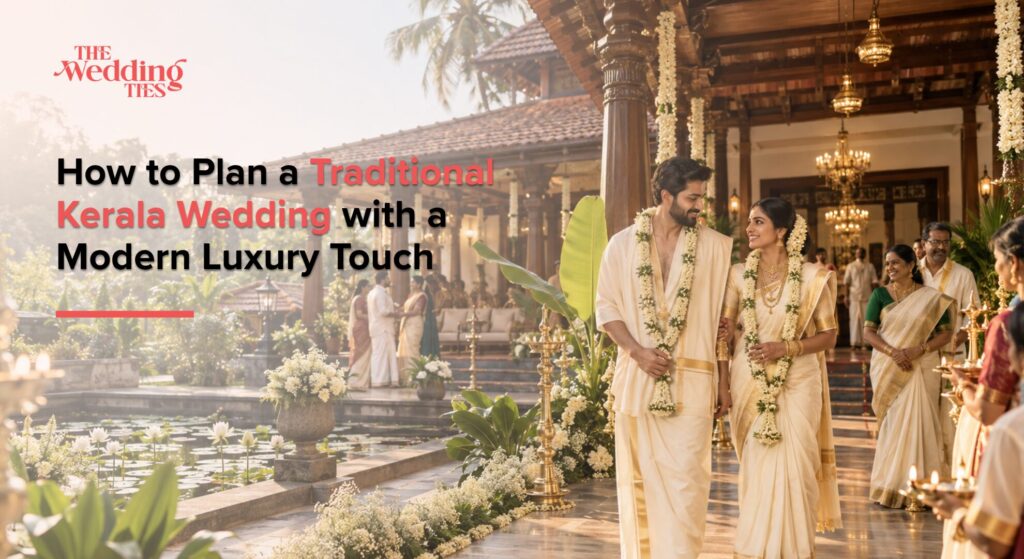
The first picture is inherited. A brass lamp burning at dawn, a white and gold kasavu saree, the groom tying the thali while a chenda drum answers from somewhere behind the crowd, and a banana leaf laid out for four hundred people. The second picture is theirs. Still water, a lit-up lawn at dusk, good glassware, a playlist that is not a wedding playlist, and a celebration that feels considered rather than just large.
Our answer is always the same: you do not have to choose. A Kerala wedding is one of the few Indian weddings where the tradition is already restrained, already elegant, already built on white, gold and green. Luxury does not have to be layered on top of it. It has to be built around it. Here is how we approach that, step by step.
What makes a Kerala wedding different from other South Indian weddings
Before you plan anything, it helps to understand one thing: the Kerala wedding ceremony is short. Remarkably short. Where a Punjabi or Marwari wedding can stretch a ceremony across three or four hours, the core Kerala Hindu ritual – the groom tying the thali, the pudamuri, the garland exchange, the blessings from elders – can be finished inside thirty minutes.
That single fact changes your entire plan. It means the ceremony is not the event you build the day around; the ceremony is the anchor, and everything else – the arrival, the feast, the evening reception – is designed to hold it. Couples who miss this end up with a rushed, badly lit ten minutes at the centre of a very expensive weekend.
It also means Kerala rewards restraint. The décor language is already minimal. Overload it and it stops looking like Kerala.
Step 1: Fix the muhurtham first, then design the day backwards
In most Indian weddings, the auspicious time is a window. In Kerala, it is a minute. The family astrologer calculates the exact moment for the thali to be tied, and families take that timing extremely seriously – being seated and ready well before it is not optional.
Those moments frequently land between 5:00 am and 9:00 am. That is beautiful, and it is also a logistical problem nobody warns you about. Working backwards from a 6:40 am muhurtham, a realistic morning looks like this:
- 1:30 am – Bridal hair and makeup begins. Two artists minimum, not one.
- 3:30 am – Décor team’s final flower refresh; jasmine strung the night before will have wilted.
- 4:30 am – Lighting check. At that hour you are shooting in darkness, so the mandapam needs proper warm lighting, not string lights.
- 5:15 am – Guest transport leaves the hotel. Elderly guests need to be picked up separately and seated first.
- 6:00 am – Groom’s arrival with nadaswaram or chenda melam.
- 6:40 am – Muhurtham.
- 7:30 am onward – Sadya service begins in batches.
Once you see the morning written out like that, the luxury decisions make themselves. You need on-site accommodation. You need a second glam team. You need lighting designed for pre-dawn. Our Logistic Management team builds this hour-by-hour sheet before a single vendor is confirmed, and we cover the broader method in our guide on how to create the perfect wedding timeline.
Step 2: Choose the region before you choose the venue
Kerala is not one destination. It is four, and they behave very differently. Pick the region that suits your guest count and your temperament, then shortlist properties inside it.
The backwaters (Kumarakom, Alleppey, Ashtamudi). The most recognisably “Kerala” option. Still water, palm cover, boat arrivals. Best for 80–300 guests. Some of the finest properties here are reached only by boat, which is magical for guests and demanding for décor load-in.
The coast (Kovalam, Bekal, Marari, Poovar). Cliff-top and beach settings that scale. If your guest list runs past 400, this is usually where it goes.
The hills (Munnar, Wayanad, Thekkady). Tea estates, mist, cool evenings. Naturally intimate – most estate properties cap out well below 200, which suits couples who want a small, private celebration.
Heritage Kochi (Fort Kochi, Bolgatty Island, Willingdon Island). Our quiet recommendation for most families. You get harbour views, colonial architecture and genuine atmosphere, but your florist, caterer and lighting crew are thirty minutes away instead of three hours. The saving on vendor logistics alone is significant.
If you are still comparing Kerala against other options, our round-up of the top destination wedding locations in India sets it side by side with Goa, Udaipur and Jaipur. And if the whole idea is still new to you, start with what a destination wedding actually involves.
One practical note on boat-access venues: confirm in writing how generators, cold storage, floral stock and a wet-weather structure will reach the island, and how many round trips the property allows per day. We ask this question in every venue sourcing conversation because the answer decides what kind of décor is even possible.
Step 3: Decide what stays untouched and where luxury goes in
This is the heart of the brief, so we treat it as a deliberate exercise with the families. We draw a line down the middle of the plan.
What we never modernise:
The muhurtham timing and the sequence of rituals.
The nilavilakku, the ashtamangalyam and the mandapam’s ritual elements.
The bride’s kasavu – white, gold-bordered, and left alone.
The sadya served on a banana leaf.
The elders’ role in the blessings.
Where modern luxury belongs instead:
Arrival and hospitality. An airport greeting desk, a car assigned per family, a cold towel and tender coconut on arrival, a printed itinerary card in each room.
Lighting and sound. The single biggest visual upgrade available to a Kerala wedding, and the one most often underfunded.
The evening reception. This is your free canvas. A contemporary bar, a curated live act, modern styling – none of it disturbs the morning ritual.
Attire for the rest of the family. Grooms are increasingly choosing a tailored mundu with a structured jacket, or switching to a sherwani for the reception only.
Documentation. A cinematographer who understands low light, plus a second unit purely for the guest experience.
Once you frame it this way, families stop arguing about “traditional versus modern.” They are no longer competing for the same space.
Step 4: Décor - the Kerala palette, done richly
The traditional Kerala palette is white, ivory, gold and green, built from nilavilakku lamps, banana stems, coconut fronds, jasmine and marigold. It is already a luxury palette. What separates an ordinary setup from an extraordinary one is not more colour – it is depth, volume and light.
Three things we push for on every Kerala mandapam:
Volume over variety. One flower used in enormous quantity – thousands of jasmine strands, or a wall of tuberose – reads as luxury. Six flowers mixed together reads as a vendor’s default package.
Warm lighting hidden inside the structure. Uplighting on banana stems and backlighting behind the mandapam transforms a dawn ceremony. Cold white LED flattens everything.
Texture from the region. Aged brass, carved teak, terracotta, handloom, temple-mural motifs printed onto stationery and signage rather than onto the backdrop.
Our decor design and execution team builds mood boards around this discipline, and you will find more cross-regional inspiration in our piece on wedding décor themes for Indian weddings.
A word of caution on climate. Kerala is humid, and fresh florals installed the previous evening will not survive to a dawn muhurtham. Budget for a pre-dawn refresh, keep flowers in cold storage until the last possible hour, and never place an open-flame lamp where the sea breeze can reach it.
Step 5: Sadya, elevated - not replaced
Every couple eventually asks whether they can swap the sadya for live counters. Our advice is firm: do not. The sadya is the emotional centre of the meal, and for many guests it is the part they will describe to other people afterwards.
What you can do is raise its execution:
Service ratio. A proper sadya is served seated, in sequence, by hand. One server per eight to ten guests, minimum. Understaffing is what makes a sadya feel chaotic rather than ceremonial.
Seating in planned batches. Publish the batches on your itinerary so families are not standing in doorways.
The leaf itself. Uniform, full-size, unblemished plantain leaves, laid the same way at every seat. It sounds small. It photographs enormously.
Payasam as the finale. Two or three varieties, served warm, announced properly.
Then let the other meals be contemporary. A Malabar-inspired dinner on the eve, a seafood grill on the beach, an Ayurvedic breakfast spread, a late-night appam and stew counter after the reception. You keep the tradition intact and still give your guests range across the weekend.
Step 6: Entertainment that belongs to the place
Kerala gives you performance traditions most destinations simply do not have, and they are far more memorable than a generic DJ set.
Chenda melam or panchavadyam for the groom’s arrival – percussion that genuinely announces something is happening.
Nadaswaram and thakil through the ceremony itself.
Thalapoli – young women holding decorated lamps and flowers to line the entrance path.
Kathakali or Mohiniyattam as a curated twenty-minute set during the welcome dinner. Introduce it briefly so guests understand what they are watching; an unexplained performance is wasted on half the room.
A boat entry at a backwater venue, if the property’s jetty and water conditions allow it.
Keep the modern entertainment for the reception – a live band, a DJ, a choreographed family set. Our artist sourcing and management team books traditional and contemporary acts through the same contract so scheduling never collides, and our photographer and choreographer team coordinates rehearsal slots around it.
Step 7: The permissions nobody mentions until it is too late
This is where a Kerala wedding differs sharply from Goa or Rajasthan, and where most online guides go quiet.
Alcohol. Kerala has a stricter licensing regime than most states. Alcohol is served through licensed hotel premises, and the state observes a dry day on the first of each month. The government has since relaxed this specifically for tourism: three-star-and-above properties, including heritage and boutique categories, can apply for a one-day permit to serve at an approved function such as a wedding reception on that date.
The application goes to the Excise Commissioner at least seven days ahead and carries a fee of ₹50,000. Other declared dry days – religious observances and election days – are not covered. You can check current rules directly with the Kerala State Excise Department.
The practical takeaway: if alcohol matters to your celebration, ask about the property’s licence before you book the date, not after.
Sound. Amplified music outdoors is restricted after 10 pm under national noise regulations. Plan the loud portion of your reception for 8 pm to 10 pm and move the afterparty indoors.
Access and travel. Kochi, Thiruvananthapuram and Kozhikode all take direct flights, and Kochi is the easiest for international and NRI guests. Block transfers early – Cochin International Airport to Kumarakom is roughly two hours by road, and guests arriving on late flights will need a dedicated desk.
Step 8: Guest experience, which is where the "luxury" is actually felt
Guests rarely remember the cost of your mandapam. They remember whether they were looked after.
Send the itinerary before they pack. Dawn ceremony, humid afternoons, cool hill evenings – people need to know. Our Itinerary & RSVP team handles this digitally, and our guide on managing wedding RSVPs covers the tracking side.
Build the welcome hamper around Kerala. Banana chips, tea or coffee from a named estate, a small brass piece, coconut oil, a handloom stole. Our hampers and gifting team sources these locally rather than shipping generic kits in.
Add one shared experience. A sunset backwater cruise, an Ayurvedic spa block, a Kathakali make-up demonstration, a spice-plantation morning. One is enough; three exhausts people.
Print beautifully. Invitations, place cards, leaf-side menus and room itineraries drawn from Kerala’s mural and brass motifs pull the whole weekend together. Our collateral design and printing team treats this as part of the décor, and our piece on wedding invitation trends has more ideas.
Step 9: Season, booking window and budget realism
Season. October to March is the comfortable window – drier air, lower humidity, clear skies. The south-west monsoon arrives around June and the landscape is spectacular, but an outdoor plan then needs a fully costed covered alternative, not a hopeful one.
Booking window. For a peak-season date at a sought-after backwater or coastal property, work to ten to fourteen months. Properties that host only one wedding at a time – heritage houses, island resorts, estate stays – close out first. Off-season dates can often be confirmed inside four to six months at materially better rates. If your timeline is already tight, our guide on planning a wedding in under six months is the honest version of what is still achievable.
Budget. Kerala’s cost spread is wide. Per-plate catering at good properties commonly sits in a mid-range band, while the top backwater and cliff-top resorts run several times higher. Rather than chasing a headline number, decide early which three elements you want to be genuinely excellent – usually venue, food and lighting and let the rest be competent. That single decision protects more weddings than any spreadsheet.
How we plan Kerala weddings at The Wedding Ties
We start with three conversations, not three quotations: what the families will not compromise on, what the couple wants the weekend to feel like, and where the money should genuinely go. From there we lock the muhurtham and the venue together, because in Kerala one dictates the other.
After that, our in-house teams take over the moving parts – venue sourcing, décor, vendor sourcing and management, logistics and guest hospitality – under one point of contact, so your family is never chasing six different numbers. Our wider method is set out in the guide to wedding event management, and because things do occasionally go sideways, we plan for that too, as described in our piece on handling last-minute wedding emergencies.
You can see the range of celebrations we have delivered across India on our real weddings page.
Frequently asked questions
1. How many days should a Kerala destination wedding run?
Three nights works for most families. Day one for arrivals and a welcome dinner, day two for haldi or mehendi and the sangeet, day three for the dawn muhurtham, sadya and evening reception, with a farewell brunch before departures.
2. Can we hold the ceremony on a houseboat or by the water?
Yes, with conditions. Houseboats suit intimate ceremonies and boat entries beautifully, but capacity, safety clearances and a wet-weather alternative all need to be settled in writing first. Larger ceremonies are better held at a waterfront lawn with the boat used for the arrival.
3. Is a Kerala wedding cheaper than Goa or Udaipur?
Often, yes – particularly in Kochi, where the vendor ecosystem is local. Remote backwater and hill properties can cost more than expected once vendor travel, accommodation and multiple load-ins are counted, which is why we compare total landed cost rather than venue rate.
4. Will our North Indian guests enjoy a sadya?
Almost always, provided it is explained. We include a short leaf-side card describing the dishes and the order in which they are eaten. Guests who understand what is in front of them enjoy it far more.
5. Do we need a local planner as well?
No. We work with a vetted Kerala ground network and station our own team on site for the full duration, so you have one accountable partner rather than a chain of handovers.
Let's plan yours
A Kerala wedding does its best work when the tradition is left alone and the hospitality around it is exceptional. That balance is not luck – it is planning, and it is what we do.
Tell us your dates, your guest count and the picture in your head, and we will tell you honestly what it will take.
Call us: +91 90760 01926
Email: connect@theweddingties.com